Saturday, July 5, 2008

GARMISCH-PARTENKIRCHEN 1936 IV Olympic Winter Games


The 1936 Games were held in the twin Bavarian towns of Garmisch and Partenkirchen. An efficient bus service allowed 500,000 people to attend the final day's events. Alpine skiing events were included for the first time, and this led to a major controversy. The IOC, overruling the International Ski Federation (FIS), declared that ski instructors could not take part in the Olympics because they were professionals. Incensed, the Austrian and Swiss skiers boycotted the events. The dispute carried on after the Games and it was decided that skiing would not be included in the 1940 Olympics. Sonja Henie earned her third gold medal and Karl Schäfer his second. Speed skater Ivan Ballangrud of Norway won three of the four races, including the 500m, the shortest race, and the 10,000m, the longest. Great Britain upset Canada in ice hockey, but it should be noted that ten of the twelve British players lived in Canada.

Dates : February 6 to 16
Participating N.O.C.: 28
Number of Sports : 6
Number of Events : 16
Number of Athletes : 668
Men : 588
Women : 80
Opening : Chancellor Adolf Hitler
Oath : Wilhelm Bogner
Candidates cities : St Moritz (SUI)

Friday, July 4, 2008

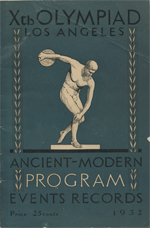
LOS ANGELES 1932 Games of the X Olympiad


Because the 1932 Olympics were held in the middle of the Great Depression and in the comparatively remote city of Los Angeles, half as many athletes took part as had in 1928. Nevertheless, the level of competition was extremely high and 18 world records were either broken or equalled. The crowds set records too, starting with the 100,000 people who attended the Opening Ceremony. The 1932 Olympics were the first to last 16 days. The duration of the Olympics has remained between 15 and 18 days ever since. Between 1900 and 1928, no Summer Olympics was shorter than 79 days. For the first time, the male athletes were housed in a single Olympic Village. (The women stayed in a luxury hotel.) At the victory ceremonies, the medal winners stood on a victory stand and the flag of the winner was raised. Official automatic timing was introduced for the track events, as was the photo-finish camera. 14-year-old Japanese Kusuo Kitamura won the 1,500m freestyle to become the youngest male in any sport ever to earn a gold medal in an individual event. 21-year-old American Babe Didrikson qualified for all five women’s track and field events, but was only allowed to compete in three. She won the javelin throw and set world records in the high jump and the 80m hurdles. Ivar Johansson, a Swedish policeman, won gold medals in both freestyle and Greco-Roman wrestling. Another Swedish wrestler, Carl Westergren, won his third Greco-Roman title, each in a different division. In the spirit of fair play, British fencer Judy Guinness gave up her hopes for a gold medal when she pointed out to officials that they had not noticed two touches scored against her by her final opponent, Ellen Preis of Austria.

Dates: July 30- August 14
Participating N.O.C.: 37
Number of Sports: 15
Number of Events: 128
Number of Athletes: 1 503
Men's : 1 468
Women's : 35
Opening: Charles Curtis, Vice-President of USA
Oath : George C. Calman
Candidates cities: None

Thursday, July 3, 2008

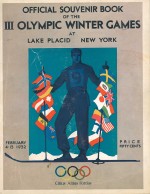
LAKE PLACID 1932 III Olympic Winter Games


The third Winter Olympics, in 1932, were held in Lake Placid, New York State, a town of fewer than 4,000 people. Faced with major obstacles raising money in the midst of a depression, the president of the organizing committee, Dr. Godfrey Dewey, donated land owned by his family to be used for construction of a bobsleigh run. Sonja Henie defended her figure skating title, as did the French pair of Andrée and Pierre Brunet. However Gillis Grafström was thwarted in his attempt at winning a fourth gold medal, placing second behind Austrian Karl Schäfer. Billy Fiske of the United States won a second gold medal in the four-man bobsleigh. One member of Fiske’s team was Eddie Eagan, who had won the light-heavyweight boxing championship at the 1920 Antwerp Olympics. Eagan remains the only person in Olympic history to earn gold medals in both Summer and Winter sports.

Dates: February 4 - 15
Participating N.O.C.: 17
Number of Sports: 5
Number of Events: 14
Number of Athletes: 278
Men: 257
Women: 21
Opening : The Governor of the State of New York, Franklin D. Roosevelt
Serment: John Ames "Jack" Shea
Candidates cities: Montreal (CAN), Bear Mountain, Yosemite Valley, Lake Tahoe, Duluth, Minneapolis and Denver (USA)

Wednesday, July 2, 2008

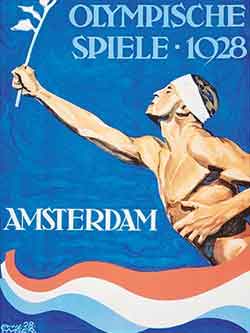
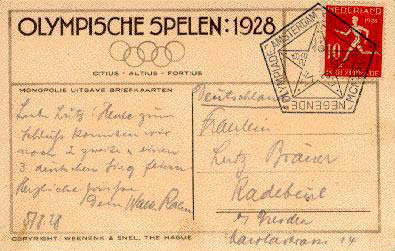
AMSTERDAM 1928 Games of the IX Summer Olympiad


The Amsterdam Olympics of 1928 were held in an atmosphere of peace and harmony that preceded twenty years of economic uncertainty and war. Perhaps the Games were best exemplified by the experience of Australian rower Henry Pearce. Midway through his quarterfinal race, he stopped rowing to allow a family of ducks to pass single file in front of his boat. Pearce won the race anyway and, later, the gold medal as well. At the Opening Ceremony, the team from Greece led the Parade of Nations and the host Dutch team marched in last. Greece first, hosts last would become a permanent part of the Olympic protocol. Athletes from 28 different nations won gold medals in Amsterdam, a record that would last for 40 years. The number of female athletes more than doubled as women were finally allowed to compete in gymnastics and athletics. For the first time, Asian athletes won gold medals. Mikio Oda of Japan won the triple jump, while his teammate, Yoshiyuki Tsuruta, won the 200m breaststroke. Meanwhile the team from India swept to victory in field hockey. Between 1928 and 1960, Indian teams won six straight gold medals. Another winning streak began in 1928. Hungary earned the first of seven consecutive gold medals in team sabre fencing.


Dates: July 29- August 12
Participating N.O.C.: 46
Number of Sports: 14
Number of Events: 109
Number of Athletes: 3014
Men's : 2724
Women's : 290
Opening: HRH Prince Hendrik
Oath : Henry Denis
Final Torch Bearer: Unknow
Candidates cities: Los Angeles (USA)

Tuesday, July 1, 2008

ST. MORITZ 1928 II Olympic Winter Games


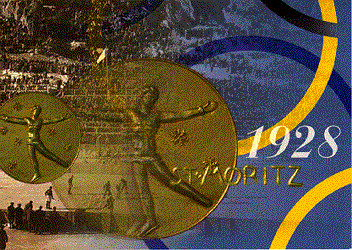
The 1928 Winter Games, hosted by St. Moritz, Switzerland, were the first to be held in a different nation than the Summer Games of the same year. A new event was contested: the skeleton, which is like luge except that the athletes descend headfirst. Speed skater A. Clas Thunberg added two more gold medals to the three he had won in 1924. Johan Grøttumbråten of Norway won the 18km cross-country event and the Nordic combined. Another Norwegian, Sonja Henie, caused a sensation by winning the women’s figure skating at the age of fifteen. Her record as the youngest winner of an individual event stood for 74 years. In men’s figure skating, Gillis Grafström of Sweden won his third straight gold medal. Canada again dominated the ice hockey tournament, winning their three matches 11-0, 14-0 and 13-0.

Dates : February 11 - 19
Participating N.O.C.: 25
Number of Sports : 6
Number of Events : 14
Number of Athletes : 464
Men : 438
Women : 26
Opening : President of the Helvetic Confederation Edmund Schulthess
Oath : Hans Eidenbenz
Candidates cities: Davos and Engelberg (SUI)